

Forest carbon accounting in the GHG Protocol
Discover this blog post
The GHG Protocol's Land Sector and Removals Standard (LSRS), published in January 2026, left one major question open: how to account for forest carbon. In our latest Carbon Expert Series webinar, Kenneth Van den Bergh (CEO and co-founder, Carbon+Alt+Delete) was joined by Professor Miguel Brandão (Riga Technical University), who has worked in carbon accounting for around 20 years and sat on the GHG Protocol technical working group on this topic.
A new topic for most
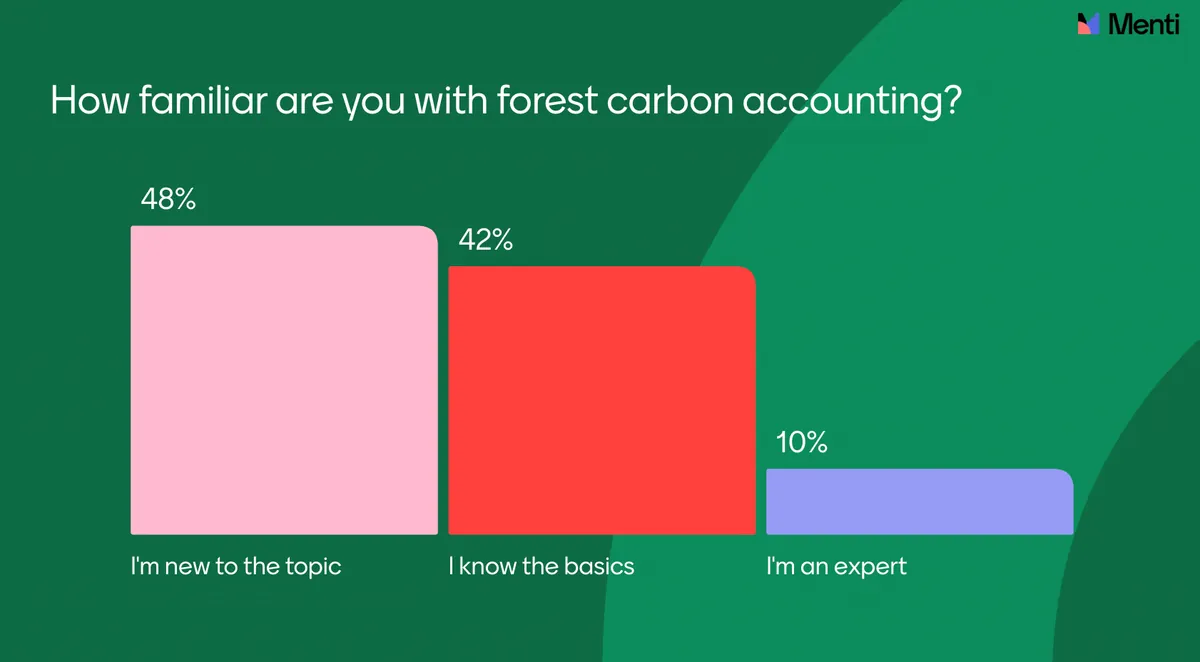
48% of participants were new to forest carbon accounting, 42% knew the basics, and 10% considered themselves experts.
Where the GHG Protocol stands
The working group developed two proposals, but the Independent Standards Board approved neither. A request for information is now open until 1 February 2027, and Miguel encouraged consultants with hands-on experience to respond.
The three approaches:
- Managed land proxy (MLP): a buyer receives a share of forest carbon change across its sourcing region.
- MLP plus: MLP in the inventory, plus a separate forest impact assessment.
- Activity-based accounting (ABA): similar to LCA, it compares forest and product carbon with and without the harvest.
Following the carbon
Miguel stressed that no one is against forestry. But being preferable to other materials doesn't make wood's emissions zero or negative.
- Most wood is burned: globally, more than two-thirds of harvested wood is burned soon after harvest; only about a fifth becomes a solid product.
- Regrowth isn't payback: a regrown stand may still sit below where the unharvested forest would have been. That gap is the forest carbon cost.
An ABA starts by specifying the decision, defining a credible reference case (not necessarily "no harvest forever"), and following forest carbon, product carbon and end-of-life releases in both cases over the same period.
The problem with regional allocation
Miguel used Poland as an example. Its forests take up about 60 million tonnes of CO₂ a year against a harvest of about 20 million cubic metres, which gives 3 tonnes of removals per cubic metre. A 1,000 m³ order earns 3,000 tonnes. Cancel the order and the tonnes vanish from the spreadsheet, but if the supplier sells the logs elsewhere, nothing changes in the forest.
This creates perverse incentives:
- Inefficient mills look better: they buy more fibre, so they receive more credit.
- Recycled fibre is penalised: virgin paper can appear to have the lower footprint.
- Pellets: bioenergy can appear carbon negative before any comparison with an alternative fuel.
Who caused the growth?
Much of today's forest uptake has nothing to do with today's buyer:
- Legacy regrowth: forests on former farmland, or recovering from past cutting, are still accumulating carbon from decisions made decades ago.
- The passive sink: rising CO₂ and nitrogen deposition boost growth everywhere, including in forests that supply nothing.
There's also a double-counting risk: GWP100 already includes land and ocean uptake in its CO₂ reference, so crediting buyers for background uptake counts it twice.
MLP's appeal is practical, because it uses data national inventories already produce. But those inventories weren't designed to rank products. As Miguel showed, a company that cuts emissions from 100 to 10 tonnes but keeps claiming 10 tonnes of background uptake can report net zero without addressing its remaining emissions. MLP plus adds information but risks giving procurement two conflicting numbers.
Three questions for every forest carbon claim
- What is the activity, and what would plausibly happen without it?
- Where does the carbon go, including the forest, products and end of life?
- Which removals did the activity genuinely cause?
Conclusion
Regional allocation is easy to implement but can credit buyers for growth they didn't cause. Until the GHG Protocol decides, consultants should question negative wood footprints, check each method's reference case, and consider responding to the consultation before 1 February 2027.
Learn more about forest carbon accounting by watching the full webinar hosted by Kenneth Van den Bergh (Co-Founder & CEO Carbon+Alt+Delete) & Professor Miguel Brandão (Riga Technical University).
About Carbon+Alt+Delete
We provide carbon accounting software for sustainability consultants and consultancies that guide companies towards net zero.
Curious to discover how our software can improve your carbon accounting services?
Feel free to reach out to [email protected] or book a meeting to talk to one of our experts here.