

The Land Sector and Removals Standard: what carbon consultants need to know
Discover this blog post
The GHG Protocol Land Sector and Removals Standard (LSRS) is the first of this year's GHG Protocol updates to be final. It takes effect on 1 January 2027. In our latest Carbon Expert Series webinar, Kenneth Van den Bergh (CEO and co-founder, Carbon+Alt+Delete) was joined by Catherine McCosker, Head of Agriculture and Landscapes at 3Keel, which sat on the LSRS technical working group.
Key themes:
- Forests are out (for now): excluded from the physical inventory.
- Traceability drives everything: your spatial boundary decides your accounting approach and whether you can report removals.
- New metrics: land occupation, land carbon leakage and a two-inventory rule for in-chain credits.
- Data has to catch up: emission factor databases and farm calculators are still aligning.
A new topic for most
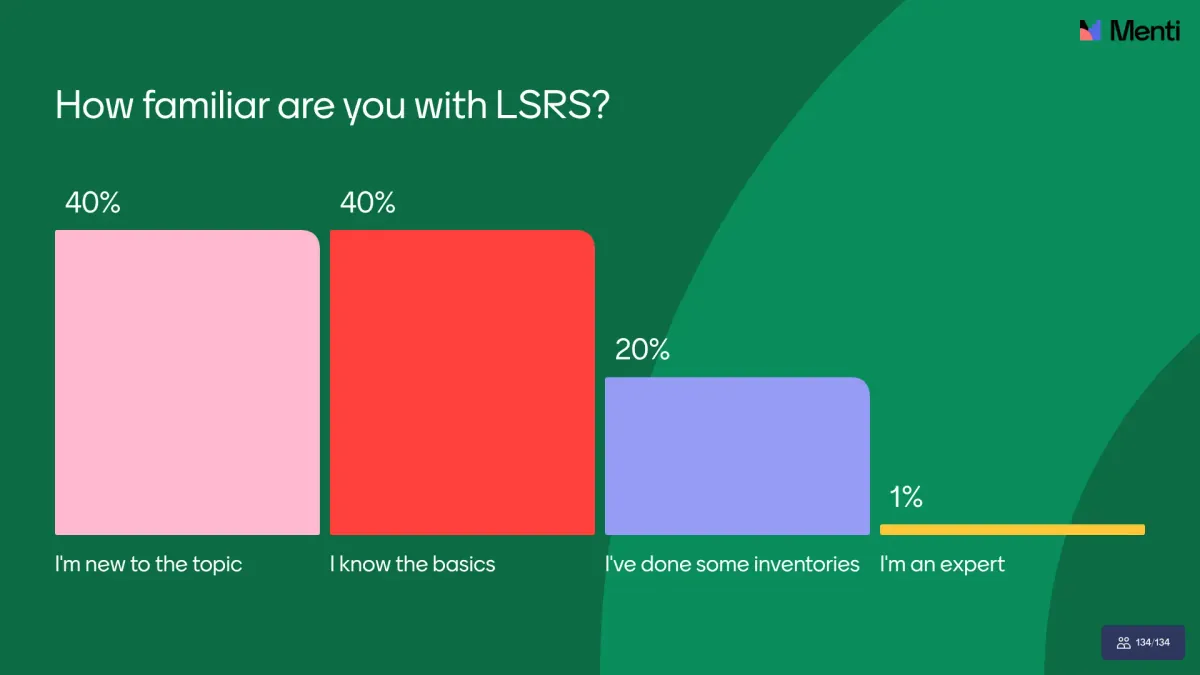
Of the 134 participants, 40% were new to the LSRS and 40% knew the basics. Some 20% had done land-based inventories, and just 1% considered themselves experts.
Where the LSRS fits
The GHG Protocol sets the accounting rules; the SBTi sets how far and how fast companies must reduce. The LSRS belongs to the first but interacts directly with the SBTi's net-zero standard and FLAG guidance.
- September 2022: first draft, followed by consultation and pilot testing.
- January 2026: final standard published, consolidated into 32 requirements.
- Companion guidance: expected around Q2 2026, explaining how to apply the requirements in practice.
- 1 January 2027: the standard takes effect.
Reporting is split between the physical inventory (core emissions and removals) and additional accounting categories (further emissions and new metrics). Both go into a GHG report, which is also the place to justify your interpretation choices.
Forests are excluded from the physical inventory
The forest subgroup could not agree which forest emissions and removals are human-caused, so forests are left out of the physical inventory for now. Report forest activity transparently outside it. Productive land such as agroforestry and tree crops stays in scope, as does deforestation through land use change emissions.
Spatial boundaries and traceability
A spatial boundary is the land area included in your accounting. For scope 3, the boundary you may use depends on how far you can physically trace your products.
The LSRS defines five boundaries, from global (no knowledge of origin) to the harvested area (the actual field). Two sit in between:
- Sourcing region: the first point of aggregation, such as a mill, elevator or dairy co-op.
- Land management unit (LMU): a farm under one management plan, now including hedgerows, buffers and woodland. Those areas can't yet be reported, due to the forest exclusion.
Reporting removals requires at least sourcing-region traceability, and emissions and removals for the same product must use the same boundary. Traceability is proven through chain of custody models: identity preserved and segregated models are accepted, and mass balance is accepted with safeguards. Impact traceability, where you can't prove physical connection, sits outside the physical inventory.
Updates to the physical inventory
- Land use change: certification cutoff dates must match the 20-year assessment period. A new jurisdictional approach lets companies use sourcing-region data, making deforestation-free commitments easier to reflect.
- Biogenic product emissions: can still be reported outside the physical inventory, under new guardrails.
- Land management emissions: stock change approach confirmed; biogenic and production emissions reported separately.
New metrics outside the physical inventory
Land occupation is required: the total hectares needed to produce what you source.
Land carbon leakage is triggered by removal programmes, regenerative agriculture or biofuel production. For the first two, it only applies if yields drop significantly, and can be waived if the activity supports long-term supply chain sustainability. Biofuels have no such exemption.
GHG credits created within your value chain require two inventories, with and without credits, to avoid double counting.
What it means for science-based targets
Existing FLAG targets only need revalidating if the LSRS compromises them. Absolute FLAG sector pathway targets are unlikely to be affected. Commodity intensity targets are more at risk: if the LSRS shifts the base-year mix, a 41% maize target might become 38%, triggering revalidation.
Getting the data right
Start with physical activity data, not spend. Spend-based data can produce a footprint but can't align with the LSRS or show impact.
The LSRS requires emissions split by gas and by biogenic versus production emissions, which most agricultural databases don't yet provide. 3Keel splits the public Agribalyse source data manually; the same is possible in ecoinvent, but its licence makes sharing factors with clients harder. Ask your data and calculator providers where they stand. A gap is not a red flag, as almost everyone is still catching up.
Removals: possible, but demanding
The LSRS adds clarity, but Catherine expects removal reporting will often remain too complex or costly.
- Dilution: at sourcing-region level you account for all land in the region, so small programmes barely show. You need LMU traceability to see results.
- Edges excluded: hedgerows and woodland hold much of the removal potential, risking a perverse incentive against whole-farm action.
- Permanence: ongoing storage monitoring is required, with buffer pools and defined monitoring periods as options. Reversals within your boundary count as emissions.
- MRV costs: soil removals require measured data and modelling.
Collaborating with suppliers spreads those costs and helps prove there is no double counting.
From the Q&A
- 2026 or 2027 data? The LSRS doesn't say. 3Keel expects 2027 data onwards to be aligned. Check with your auditor.
- A materiality threshold? Not in the LSRS; exclusions are set by FLAG guidance and the corporate standard.
- Aligned databases? None fully yet. ecoinvent and Agribalyse are aligning.
- Animal feed? A purchased input with its own emission factor. Imported soy can be a large share of a European meat producer's footprint.
- Netting? Report gross emissions and removals separately; a net figure can go in an additional category. As Kenneth noted, a net −2 tonnes from +5 and −7 calls for very different advice than a gross −2.
- Cascading removals? Vertically through the value chain, yes, with proven traceability. Horizontally, no.
How Carbon+Alt+Delete supports land-based reporting
We implemented land-based reporting in 2025 based on the draft guidance; about 90% of the data model carries over, and we are now aligning terminology.
- Separate dashboards for fossil, land, and gross biogenic emissions.
- Granular data points split by gas and emission type, with removals shown separately.
- Multiple databases: ecoinvent, Agribalyse, WRAP and Agri-footprint.
- Custom emission factors at the same level of detail.
- A GHG Protocol report with standard tables for fossil and land emissions, removals and gross biogenic emissions.
For mid-chain companies such as food processors, the LSRS needs no new activity data. Once software and databases catch up, Kenneth expects reporting to run fairly smoothly. The real challenge is turning results into action, which is where consultants come in.
Conclusion
The LSRS brings clarity but raises the bar. Traceability determines what you can report, forests remain unresolved, and removals bring heavy monitoring demands. For 2027, consultants should secure physical activity data, check provider alignment and help clients build traceability where it matters.
Learn more about the Land Sector and Removals Standard by watching the full webinar hosted by Kenneth Van den Bergh (Co-Founder & CEO Carbon+Alt+Delete) & Catherine McCosker (Head of Agriculture and Landscapes at 3Keel).
About Carbon+Alt+Delete
We provide carbon accounting software for sustainability consultants and consultancies that guide companies towards net zero.
Curious to discover how our software can improve your carbon accounting services?
Feel free to reach out to [email protected] or book a meeting to talk to one of our experts here.