

What's new in the SBTi Corporate Net-Zero Standard v2
Discover this blog post
Version 2 of the SBTi Corporate Net-Zero Standard is one of the most significant updates to corporate target setting since the Science Based Targets initiative was founded. During our recent webinar, Kim Schoppink, Regional Lead for Europe at the SBTi, walked participants through the key changes and the reasoning behind them. Kenneth Van den Bergh, CEO and co-founder of Carbon+Alt+Delete, moderated the session.
In this blog we dive deeper into what v2 changes, and what it means for the consultants guiding companies through it:
- One standard for both near-term and long-term targets
- A shift from setting ambition to delivering on it
- More flexibility for scope 3, without lowering the bar
- Stronger accountability through progress assessments
A familiar topic, a new standard
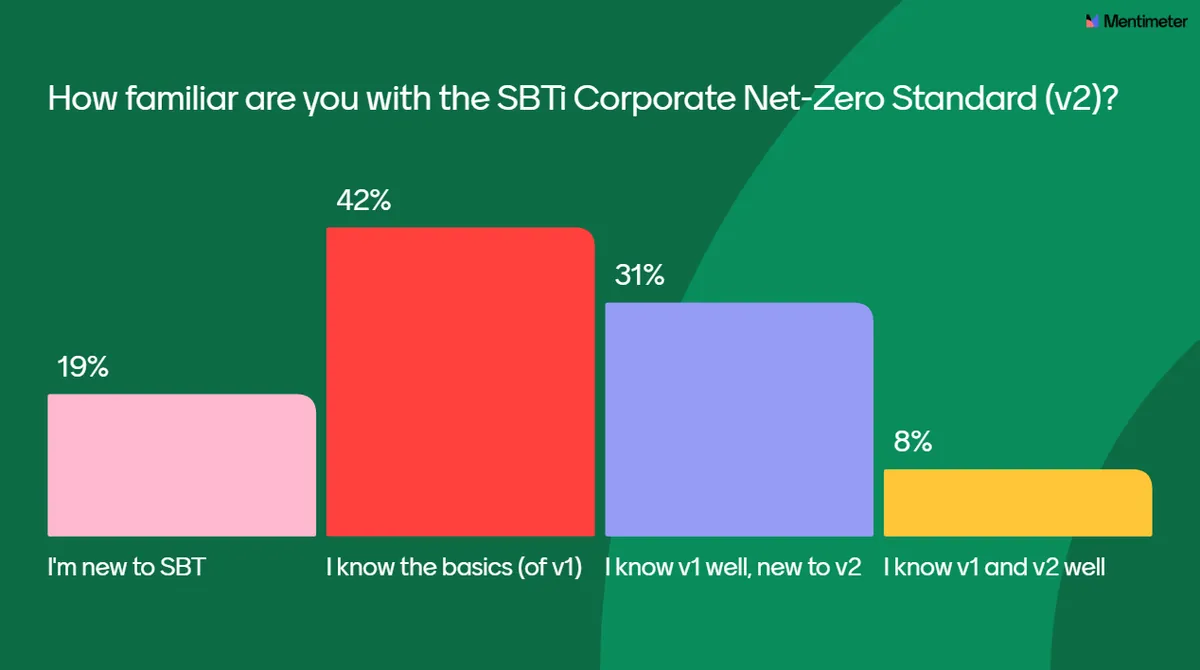
Before diving in, we asked participants how well they knew the standard. The results confirmed what we expected: around 80% already had experience with science-based targets, but v2 was still new territory for the large majority.
Most participants were sustainability consultants, sitting right where the standard's requirements meet the practical questions of companies. As Kim put it, v2 gives them an opportunity to have different conversations with clients about what it really takes to reach net zero.
The big picture
More than 11,800 companies have set science-based targets, covering over 40% of global market capitalisation. V2 replaces both the Corporate Near-Term Criteria and Net-Zero Standard v1 with one standard for near-term and long-term targets. It was shaped by 1,770+ consultation responses, pilot testing with 320 companies and five expert working groups.
The transition is gradual. V2 launched in 2026, opens for validations in 2027 (when companies can choose between v1 and v2) and becomes mandatory in 2028. Existing targets remain valid until the company's five-year review.
V2 also introduces two company categories. Category A covers larger companies in high-income countries, based on thresholds for turnover, headcount, balance sheet and scope 1+2 emissions. Category B is every other company. Several requirements are mandatory for A and optional for B. European SMEs on the current SME route will most likely fall into Category B.
Chapter 1: Net-zero governance
Targets now need the backing of the company's highest governance body, which takes overall accountability for setting, submitting and implementing them. Companies document their governance structures and their processes for reporting and reviewing targets.
Every company must also develop a transition plan with the actions and timelines needed to deliver its targets. Category A companies publish it within 15 months of submission; the SBTi does not validate it.
Chapter 2: Target base year assessment
New near-term targets are now based on the most recent year with comprehensive data, so every cycle starts from the company's current emissions profile. Alongside a GHG Protocol-aligned inventory, companies report their total electricity consumption and share of low-carbon electricity, plus a separate account of market instruments. Category A companies also need limited third-party assurance.
Scope 3 reporting zooms in on hotspots. Category A companies report scope 3 categories above 5% of total scope 3, and emissions-intensive activities above 5%, such as steel, cement, plastics or road freight (listed in Annex A).
Chapter 3: Target setting
Companies now set a separate target for each scope, and every near-term target runs a fixed five years. Long-term targets stay optional in most cases.
The biggest innovation is the alignment target. Because scope 3 data is often hard to collect, companies can track whether value-chain activities are moving towards net zero instead, such as the share of suppliers with science-based targets or of low-carbon steel sourced. As Kim put it, alignment is a leading indicator of emission reductions.
- Scope 1: absolute or intensity targets, plus a new asset transition method based on an asset decarbonisation plan for high-emitting assets. Combined scope 1+2 targets are no longer allowed.
- Scope 2: an absolute (location-based) reduction target, or a new alignment target to grow the share of low-carbon electricity (generation at or below 0.048 kg CO₂/kWh).
- Scope 3: the 67% coverage rule makes way for all significant categories above 5%, with exclusions such as employee commuting. Next to emission reduction targets, companies can use supplier/customer, volume, product use and product end-of-life alignment targets.
Chapter 4: Target implementation
This entirely new chapter introduces the implementation hierarchy. Companies take action closest to the emission source first, and only move down a level once feasible options are exhausted and barriers are justified:
- Activity level: direct action, such as electrifying on-site combustion or installing on-site renewables.
- Activity pool: shared systems the company sources from, such as buying renewable gas certificates injected into the same gas grid.
- Sector level: market instruments or projects in a relevant market outside the activity pool.
- Enabling actions: for example funding green hydrogen or advocating for grid investment. These don't count towards targets, but are recommended as best practice.
For electricity, market instruments must meet new rules on deliverability, a 15-year age limit for generators and 12-month temporal matching.
Chapter 5: Reporting and assessing target progress
V2 adds a new validation cycle. Companies report progress publicly every year and submit an end-of-cycle assessment to the SBTi after each five-year target, which informs their next target. Under a best-efforts approach, companies that fall short because of external barriers can still set new targets, provided they used all available levers and disclose those barriers.
Chapter 6: Ongoing emissions responsibility
What used to be beyond value chain mitigation becomes a three-phase framework:
- Optional recognition: companies covering part of their ongoing emissions can earn engaged, advanced or leadership recognition.
- Post-2035 responsibility: Category A companies must support a growing volume of carbon removals.
- Neutralisation: from the net-zero year, all companies neutralise 100% of residual emissions.
Conclusion
V2 brings near-term and long-term targets together in one standard, widens the toolkit with alignment targets, guides delivery through the implementation hierarchy and adds accountability through end-of-cycle assessments. More guidance follows from Q4 2026, including Methods, Metrics and Pathways, interim accounting guidance and a v1 renewal policy. Companies don't need to wait: a beta target-setting tool is already available.
This article was based on a Carbon Expert Series Webinar. Watch the full webinar on our YouTube channel.
About Carbon+Alt+Delete
We provide carbon accounting software for sustainability consultants and consultancies that guide companies towards net zero.
Curious to discover how our software can improve your carbon accounting services?
Feel free to reach out to [email protected] or book a meeting to talk to one of our experts here.