

How will carbon reporting evolve in 2026? Demand, constraints, and the role of AI
Discover this blog post
Carbon reporting is no longer an emerging discipline. It is becoming an operational requirement across European businesses. Regulatory pressure, investor expectations, and internal climate commitments are converging into a single reality: organisations need structured, repeatable, and auditable carbon data.
At the same time, the capacity to deliver that data is not scaling at the same pace.
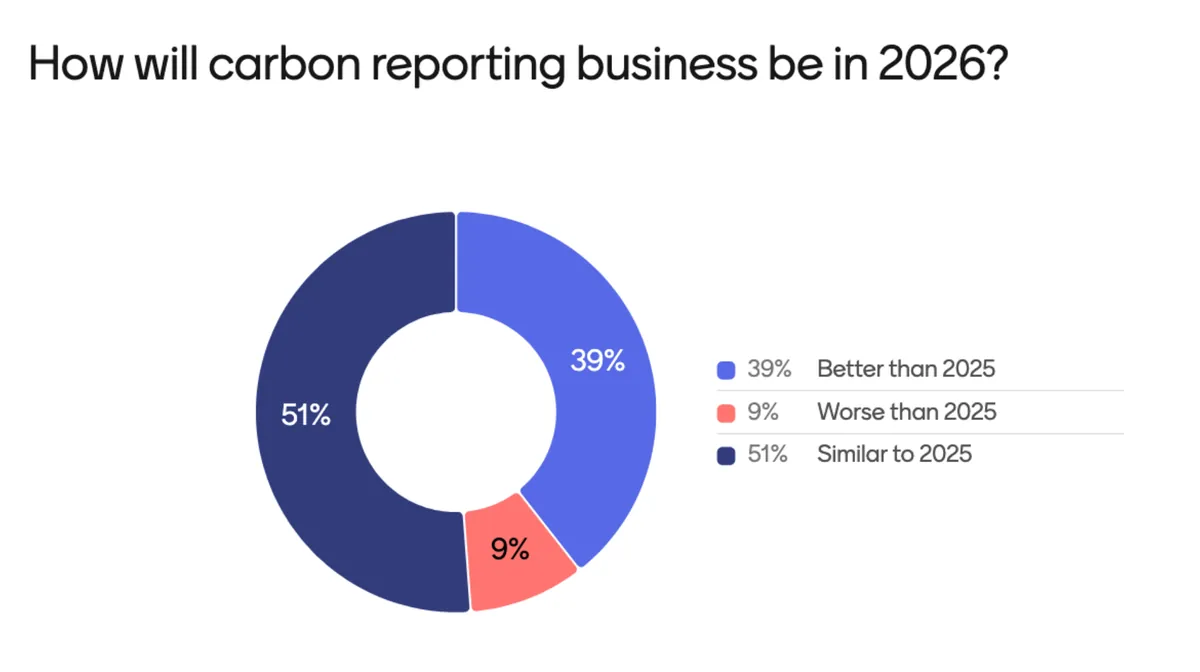
A recent survey among more than 200 sustainability consultants provides a useful snapshot of how the market perceives the near future. At first glance, this suggests stability. In practice, it reflects something else: the market is already under pressure, and incremental change is not expected to resolve the underlying constraints.
A market that is growing, but not fundamentally changing
The expectation that 2026 will look “similar” to 2025 is telling. It indicates that many of the structural characteristics of today’s carbon reporting landscape are expected to persist.
Demand is already high and continues to grow. Frameworks such as CSRD are no longer theoretical—they are being implemented, forcing organisations to formalise their reporting processes. At the same time, companies are moving beyond first-time footprinting exercises and into iterative reporting cycles, requiring higher data quality and consistency.
However, the way carbon accounting is delivered has not fundamentally changed at the same speed. Much of the work still relies on manual processes, spreadsheet-based workflows, and consultant-heavy delivery models.
This creates a structural imbalance. The question is no longer whether demand will increase, but whether the current delivery model can keep up.
What 2025 already made clear
Looking back at 2025, several positive developments have already reshaped the market.
First, there is increased regulatory clarity. Companies now have a clearer understanding of what is expected in terms of carbon reporting. This reduces ambiguity, but it also raises the bar. Reporting is no longer optional or exploratory—it is becoming embedded in compliance processes.
Second, the maturity of organisations has improved. Many companies have moved beyond initial footprint calculations and are now focused on improving data quality, aligning with targets, and integrating carbon metrics into decision-making. This shift from “measurement” to “management” is significant.
Third, the tooling landscape has evolved rapidly. Carbon accounting software is increasingly replacing manual workflows, enabling more structured data collection and processing. However, tooling alone does not solve the scalability challenge—it needs to be combined with changes in how data is processed and interpreted.
These developments suggest that carbon reporting is transitioning from a project-based activity to a continuous process. That shift, however, introduces new complexity.
Four trends shaping sustainability consulting
Building on these developments, several trends are shaping how sustainability consulting is evolving.
One of the most visible changes is the move toward standardisation. Regulatory frameworks are driving convergence in methodologies, reducing flexibility but improving comparability and auditability. This is necessary, but it also increases the need for consistent data structures and processes.
At the same time, Scope 3 emissions are becoming the dominant challenge. For many organisations, Scope 3 represents the majority of emissions, yet it remains the least structured and most difficult to measure. This shifts the focus of consultants toward value chain data, supplier engagement, and estimation methodologies.
Another important trend is the rise of audit expectations. Carbon reporting is increasingly expected to meet standards similar to financial reporting. This requires traceability, documentation, and methodological consistency. The role of the consultant is therefore expanding beyond calculation to include defensibility.
Finally, there is a shift from reporting to decision support. Organisations no longer want carbon footprints as static outputs. They expect insights that inform procurement, operations, and strategy. This fundamentally changes the value proposition of carbon accounting.
The role of AI in scaling carbon accounting
Against this backdrop, the role of AI becomes clearer.
The central constraint in carbon accounting is not a lack of frameworks or methodologies. It is the manual effort required to process large volumes of data. This is where AI begins to have a practical impact.
At Carbon+Alt+Delete, AI is applied to one of the most time-intensive steps: translating invoices into emissions data. This is done through a structured process.
The model first interprets the invoice and identifies the relevant activity according to the GHG Protocol. It then extracts physical activity data—such as energy consumption or fuel use—rather than relying on financial spend. Finally, it selects an appropriate emission factor based on the available context.
This approach allows for activity-based carbon accounting at scale, which is difficult to achieve manually.
However, the current capabilities of AI also reveal its limitations. In many cases, the model correctly identifies the activity and extracts the relevant data, but selects a less appropriate emission factor. In other cases, errors arise from a lack of context rather than incorrect data.
This highlights an important point: AI is effective at handling volume and structure, but still depends on human validation for contextual interpretation.
What carbon reporting will look like in 2026
Combining these elements, the survey results, the developments of 2025, and the current trends, a clearer picture of 2026 emerges.
Carbon reporting is unlikely to be fundamentally easier. The complexity of Scope 3, the requirements of regulation, and the expectations around auditability will remain.
What will change is how the work is done.
The delivery model will increasingly shift toward hybrid workflows. AI and software will handle large parts of data processing, while consultants focus on validation, interpretation, and decision-making. This is not a marginal improvement, it is a structural shift in how carbon accounting is performed.
Consultants will spend less time collecting and cleaning data, and more time ensuring that outputs are accurate, consistent, and useful for decision-making. This requires a different skill set, combining technical understanding with critical review.
At the same time, carbon accounting will become more integrated into business systems. Rather than being a periodic exercise, it will be embedded in financial processes, procurement systems, and operational workflows. This enables continuous data collection and reduces reliance on retrospective reconstruction.
Efficiency will become a defining factor. As demand continues to grow, the ability to deliver carbon accounting at scale, without compromising quality, will determine which organisations and consultancies can keep up.
Conclusion: stability on the surface, transformation underneath
The survey suggests that the carbon reporting business in 2026 will look similar to 2025. But this similarity is superficial.
Underneath, the system is under pressure. Demand is increasing, complexity is rising, and the traditional delivery model is reaching its limits.
The response is not a single solution, but a combination of shifts:
- more standardised frameworks
- more mature organisations
- better tooling
- and increasingly, AI-supported workflows
For sustainability consultants, the implication is clear. The role is not disappearing, but it is changing.
Carbon accounting is moving away from a manual, project-based activity toward a scalable, system-driven process. In that system, AI handles the volume, and consultants provide the judgement.
The market may look similar in 2026. The way it operates will not.
About Carbon+Alt+Delete
We provide carbon accounting software for sustainability consultants and consultancies that guide companies towards net zero.
Curious to discover how our software can improve your carbon accounting services?
Feel free to reach out to [email protected] or book a meeting to talk to one of our experts here.